


Low Rhine levels begin to disrupt German industry
Low Rhine levels begin to disrupt German industry

By Patricia Weiss and Christoph SteitzTue, August 11, 2026 at 4:05 PM UTC
0
By Patricia Weiss and Christoph Steitz
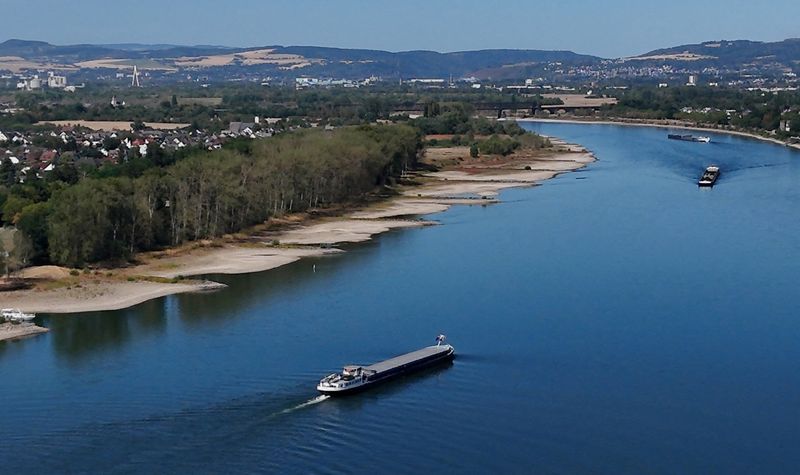
FRANKFURT, Aug 11 (Reuters) - German companies are reporting growing disruption from Rhine water levels that have hit record lows, with chemical producers, utilities, steelmakers and agricultural traders warning of higher costs, transport bottlenecks and curbed production.
While Germany has not yet suffered the widespread production outages experienced during previous Rhine crises, traders said on Tuesday that it was no longer possible to book some cargo shipments after weeks of drought and companies are increasingly reporting operational issues.
Chemicals company Covestro said the lack of transport capacity could not be offset fully despite shifting volumes to trucks and trains wherever possible and it has declared force majeure for products including polyether polyols used in mattresses and refrigerator insulation.
The Rhine is one of Europe's main arteries for transporting grains, fuels, minerals and manufactured goods, but its shallow waters are increasingly leaving companies facing higher freight costs and a lack of suitable alternatives.
"Alarm bells are ringing loudly: the extremely low water levels are increasingly pushing logistics and supply chains to their limits," Wolfgang Grosse Entrup, CEO of German chemical industry association VCI, told Reuters.
Production at rival Evonik's Marl chemical park has been hampered by reduced cargoes, it said without disclosing further details.
State-owned utility Uniper, meanwhile, pointed to lower output at its German hydroelectric plants, chiming with similar comments from local rival EnBW last week.
Advertisement
Salzgitter, Germany's second-largest steelmaker, said that the low Rhine levels had forced it to transport coal via train from Rotterdam to its HKM division.
"The current situation shows that we need to pay greater attention to waterways as part of our critical transport infrastructure," Tim-Oliver Mueller, head of the German Construction Industry Federation, told Reuters.
"Low water levels cannot be prevented."
He said certain construction materials could not easily be transported by road or rail because of capacity shortages and high volumes, with up to 150 trucks needed to replace a single barge.
At German agricultural trader RWZ, company executive Katharina Stelzer described the prospect of Rhine levels falling further as "catastrophic".
Stelzer said that in normal years, the company usually shipped 50,000 metric tons or more from its water terminals in the German cities of Worms and Andernach in the months of July and August.
She said that RWZ has not even shipped 10% of that volume in the comparable period this year and was switching to more expensive truck transport.
"If Rhine levels do not recover in October, things will get really challenging for us," she said.
(Reporting by Patricia Weiss and Christoph SteitzAdditional reporting by Petra Wischgoll, Petra Haverkamp, Emanuele Berro and Anastasiia KozlovaEditing by Matt Scuffham and David Goodman)
Source: “AOL Money”
