


Analysis-Australia promised 1.2 million new homes, but builders are at their limits
Analysis-Australia promised 1.2 million new homes, but builders are at their limits

By Scott Murdoch and Christine Chen Wed, August 12, 2026 at 1:06 AM UTC
0
By Scott Murdoch and Christine Chen
SYDNEY, Aug 12 (Reuters) - In the Australian city of Brisbane, builder Jay Perham has been forced to pour concrete at a new housing site during the night, unable to find workers for the job when the sun is up.
"That then creates quality issues, right? Because you just can't see during the night," said Perham, manager at Axiom Construction. "Probably the last three or four pours I've made have all been night time and we've been under head torches and lamps."
Brisbane, host city of the 2032 Olympic Games, is expected to see around A$7 billion ($4.93 billion) of Olympic-related construction, adding to existing shortages of workers.
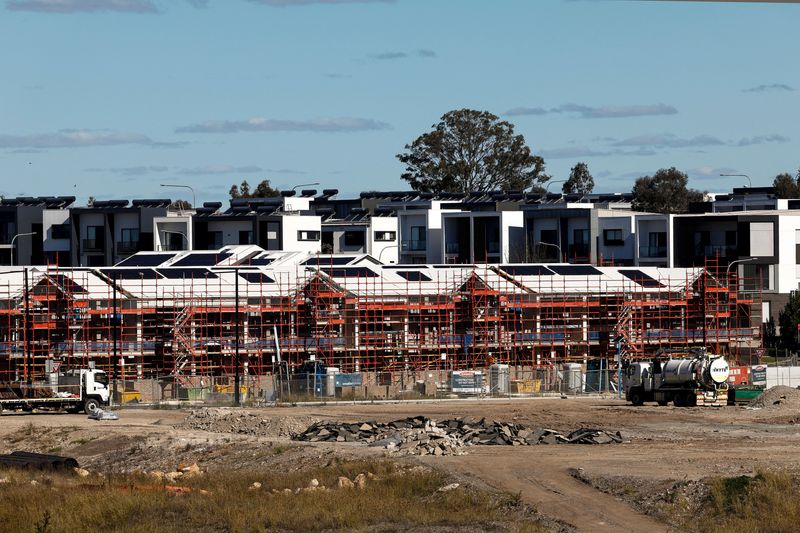
Houses and apartments, in Brisbane and across Australia, are taking longer to build and becoming more expensive to finish, which builders and analysts say undermines the government's promise to deliver 1.2 million new homes by 2029.
The five-year target, agreed with state governments and industry under the National Housing Accord, is central to Prime Minister Anthony Albanese's strategy to fix a nationwide housing shortage. It combines billions in federal funding with state commitments to fast-track approvals, rezoning and land releases for new developments.
However, two years since the agreement began, completed home construction sits 27% below the 60,000 dwellings needed on average per quarter to hit the target, official data shows.
"We can see that the annual house building numbers are not high enough to achieve the 1.2 million target across Australia," said Hal Pawson, emeritus professor of housing at the University of New South Wales.
"The capacity of the construction industry is being stressed, it's at its limits."
Pawson noted while progress across the country varies, construction is particularly struggling in Sydney, Australia's biggest city and one of the world's least affordable for housing.
A spokesperson for Australian housing minister Clare O'Neil acknowledged challenges to the "deliberately ambitious" target.
"But the answer to those challenges is not to lower our ambition – it is to keep doing everything we can to build more homes, faster," the spokesperson said in an emailed statement to Reuters.
The bottlenecks threaten to worsen affordability and underscore a challenge faced by many wealthy nations on how to build enough homes when demand for workers, infrastructure and materials outstrips supply.
Major reforms announced in May that ended the kinds of property investment tax breaks frequently blamed for inflating house prices have taken some of the heat out of the market.
Auction clearance rates are at six-year lows and average property prices are down about 2% over four months, according to data from property consultant Cotality.
However, builders argue this has done little to address the supply constraints that have plagued the industry in waves since the COVID-19 pandemic.
"It's moved the conversation about housing from how do we boost supply to a discussion about taxation and that's not helpful," said Michael Hopkins, deputy chief executive at Master Builders Queensland, an industry lobby. "We should be talking about how we boost our workforce, how we streamline our red tape and regulation."
Advertisement
New dwelling commencements in Australia fell in the first quarter of 2026 by 11.2% compared to the previous quarter, and year-on-year growth slowed sharply to 0.2% from 26.1%, official data showed. Apartment construction was the biggest drag, down 20.7% for the quarter, while house construction fell 3.5%.
Completing a new apartment now takes 33 months compared to 21 months a decade ago, Master Builders Australia says, while a house takes 11.5 months, up from 8.6 months in the same time frame.
Almost 70% of apartments approved in Australia since 2020 have not progressed to construction, according to data from consultancy Urbis shared with Reuters. The backlog was worst in the Gold Coast in Queensland, where 83% were yet to break ground, compared with 64% in Sydney and 62% in Melbourne.
"The feasibility of apartments is particularly impacted by the increase in construction costs that have happened on the back of materials, supply of labour, and the cost of finance generally," said Mark Dawson, Urbis's housing sector lead.
The Housing Industry Association, an industry group representing builders, forecasts Australia will fall short of achieving its 2029 housing target by about 15%.
DOWNTURNS DON'T HELP SUPPLY
In Brisbane, Perham said the price he pays for concrete has risen nearly 150% in the past six years, while plaster board is up 46% and pine frames rose about 35% in that time.
Sydney builder Rami Issa, director at Roar Constructions, says rising costs were eating into margins for construction firms, with many struggling to break even. To cut costs, Issa is increasingly doing much of the labour himself.
"I was never on the tools before. I was running the site, but now I'm jumping on the tools with the boys to try and cut down on working hands," he said.
Cost pressures are already squeezing the industry.
In the financial year ended June 30, 3,472 construction firms entered insolvency proceedings, appointing external administrators for the first time, down slightly from 3,596 one year prior but well up on 2,977 two years ago, data from the corporate regulator showed.
Australia's official cash rate now stands at 4.35%, having been raised three times in 2026.
With another rate hike possible before the end of the year, builders are bracing for another hit to demand.
For Kenan Yazici, general manager of Betacon Construction in Sydney, the paradox of boom-and-bust cycles in the city is that a downturn does not necessarily improve affordability.
"During the period where interest rates are going up, people pull back from development, so there's fewer projects coming onto the market," he said.
"Then all of a sudden, interest rates start to go back. Everyone flocks back to the property market. Guess what? There's not enough supply to keep up with it."
($1 = 1.4194 Australian dollars)
(Reporting by Scott Murdoch and Christine Chen in Sydney; Editing by Sam Holmes)
Source: “AOL Money”
